

Unfortunately the exact cause of infantile eczema is unknown. However we do know that it develops because of several different systems in the body interacting. These are generally some interplay between
- Skin barrier
- Immune system
- Gut and skin microbiome
Some babies are born with a skin barrier that isn’t as strong as it should be. Others have an immune system that reacts more readily to environmental triggers. Some develop changes in their skin or gut microbiome that may influence inflammation. Genetics and family history also play an important role. In the same way that some of us. always manifest physical stress through our throat, or our digestion – your baby is expressing it through their skin.
Think of eczema as a puzzle, with many small pieces fitting together. Every child has a slightly different combination of factors, which is why one baby’s eczema may respond differently to another’s. Putting together the pieces of this puzzle is the challenge of the naturopath. It is also the reason why sometimes we get resolution quickly and other times it takes a little longer to work it out.
The main factors we currently understand include:
A weakened skin barrier
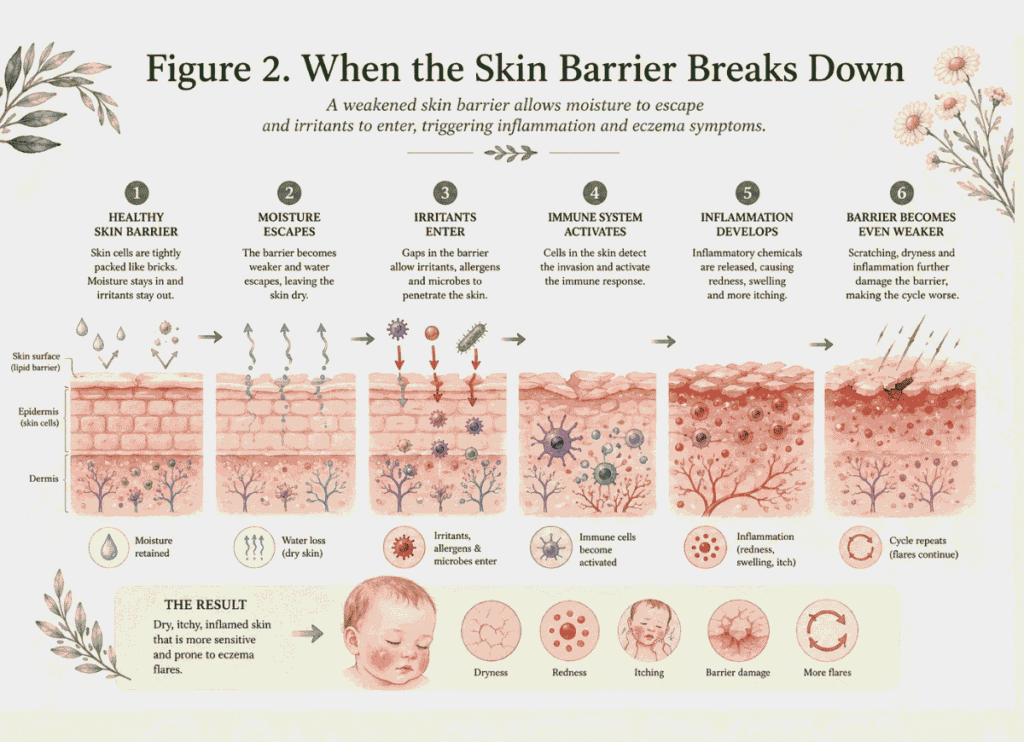
Healthy skin acts like a brick wall, preventing moisture from escaping while keeping irritants, allergens and microbes out. Skin is one of our first lines of defence, protecting our internal body from the outside world.
In babies with eczema, this barrier is naturally weaker. Water escapes more easily, leaving the skin dry and vulnerable to irritation. Tiny gaps in the skin allow irritants to penetrate more deeply, triggering inflammation and itching.
One reason some babies have a weaker skin barrier is because they produce less filaggrin, a protein that helps skin cells form a tight, waterproof barrier.
Less filaggrin means:
- weaker skin structure
- increased water loss
- less Natural Moisturising Factor
- drier skin
- higher skin pH
- reduced barrier function
- easier penetration of allergens and microbes
Why moisturisers help… and why they don’t always work
Simple moisturisers are wonderful at:
- reducing dryness
- improving comfort
- reducing steroid use
But…
Current evidence suggests that routine emollient use in healthy newborns has not consistently been shown to prevent eczema from developing, particularly in those at high genetic risk.
This doesn’t mean moisturisers don’t work.
It means:
Preventing eczema ≠ Treating eczema
An over-responsive immune system
The immune system is designed to protect us from harmful bacteria, viruses and parasites. In babies with eczema, the immune system can become overly sensitive, reacting strongly to substances that would not normally cause a problem, such as foods, soaps and/or dust.
This leads to inflammation within the skin, contributing to redness, itching and eczema flares. The immune system may just be prone to inflammation – so allergen triggers can be neutralised but inflammation continues.
Genetics
Eczema often runs in families. Children with a family history of eczema, asthma or hay fever have a higher chance of developing eczema themselves. Researchers have also identified changes in genes involved in skin barrier function, particularly the filaggrin gene, which helps keep the skin barrier strong and hydrated.
Not every child with eczema has these genetic changes, but they help explain why some babies are naturally more susceptible.
The Skin Microbiome
Healthy skin is home to millions of beneficial bacteria that help protect us from infection and communicate with the immune system.
Research has shown that babies with eczema often have reduced microbial diversity on their skin and higher levels of Staphylococcus aureus. Rather than causing eczema on its own, this altered skin microbiome may contribute to inflammation and make eczema harder to control.
The Gut Microbiome
This is an exciting area of research.
Scientists are discovering that the bacteria living in the gut help educate the developing immune system during early life. Imagine a new born immune system – It doesn’t understand friend or foe. So if a baby has a diverse and healthy microbiome it will produce lots of Regulatory T cells (Tregs). These immune system cells basically say of “Everyone calm down.” If the gut is unhealthy lacks diversity, poor pH, pathogenic bacteria – these Regulatory T cells (Tregs) will not be produced in high enough numbers and the immune system can become over reactive. Babies who develop eczema often show differences in their gut microbiome compared with babies who don’t develop eczema, although researchers are still working to understand exactly how important these changes are.
While we don’t yet know whether gut dysbiosis directly causes eczema, the close relationship between the gut, immune system and skin is becoming increasingly recognised.
Clinically I often see overgrowths of bacteria like clostridia, which once reduced in numbers, can lead to improvement in skin. It’s important to understand that in babies the gut microbiome educates the immune system.
Natural Treatment for Infantile Eczema: How a Fremantle Naturopath Can Help
There is no single treatment that works for every child with eczema. Instead, the goal is to support the skin barrier, reduce inflammation, identify individual triggers and create the best possible environment for healthy skin to repair.
Moisturise Frequently
A well-hydrated skin barrier is better able to protect against irritants and reduce water loss.
Choose a moisturiser that is:
- fragrance free
- gentle
- applied regularly, especially after bathing
Remember, moisturisers don’t cure eczema, but they are one of the foundations of eczema care.
Colloidal Oatmeal Shows Promising Research
One natural ingredient that has attracted considerable scientific interest is colloidal oatmeal.
Unlike oat oil, colloidal oatmeal is made from finely milled whole oat grain, allowing many of its beneficial compounds to come into contact with the skin.
A 2020 clinical study found that a cream containing 1% colloidal oatmeal significantly improved:
- Skin hydration
- Skin barrier function
- Eczema severity
- Skin pH
Researchers also observed:
- Greater skin microbiome diversity
- A reduction in Staphylococcus species on eczema-affected skin.
While no single ingredient works for every child, these findings suggest that colloidal oatmeal may help support both the skin barrier and a healthier skin microbiome.
Reference
Gentle Botanicals May Complement Skin Repair
For centuries, herbal medicine has used plants to help soothe irritated skin.
Some of the best-known herbs include:
Calendula
Traditionally used to soothe inflamed skin and support normal skin repair.
Chamomile
Traditionally used for irritated, itchy skin and valued for its calming properties.
Chickweed
Traditionally used to help soothe itching and cool inflamed skin.
Reduce Common Triggers
Every child has different triggers, but some of the most common include:
- Overheating and sweating
- Harsh soaps and bubble baths
- Fragranced detergents and fabric softeners
- Wool or rough fabrics
- Saliva around the mouth
- Scratching (which further damages the skin barrier)
- Secondary skin infections
- Food allergies in some children – common triggers gluten and dairy
Learning your child’s individual triggers can often make a significant difference.
During an Acute Flare
When the skin is red, inflamed or weeping, the priority is to calm and protect the skin barrier.
Depending on your child’s individual situation, your healthcare practitioner may recommend strategies such as:
- Gentle cleansing with lukewarm water.
- Medical-grade Manuka honey in selected cases and under appropriate guidance.
- Applying soothing preparations that are well tolerated by your child’s skin.
- Using barrier creams or balms to protect damaged skin while it heals.
Once the skin has settled, the focus can shift towards restoring hydration and supporting long-term barrier repair.
Looking Beyond the Skin
While eczema appears on the skin, it is increasingly recognised as a condition involving multiple body systems. At our Fremantle naturopathy clinic, we take a whole-body approach to understanding and treating infantile eczema.
For children with persistent or difficult-to-manage eczema, it may be worthwhile discussing additional factors with your healthcare practitioner, including:
- Nutrition
- Iron and zinc status
- Vitamin D
- Omega 3
- Appropriate probiotics
- Gut health
- Food allergies (where appropriate)
- Environmental triggers
- Sleep
- Stress within the family environment
Not every child will need investigations in these areas, but taking an individualised approach often helps explain why two children with eczema can respond very differently to the same treatment.
Final Thoughts
Infantile eczema can feel overwhelming, but the skin has an extraordinary capacity to heal when given the right support.
Our understanding of eczema has evolved considerably in recent years. We now recognise that healthy skin depends on a complex interaction between the skin barrier, immune system, microbiome, genetics and environment. This helps explain why there is rarely a single cause—and rarely a single solution.
By reducing unnecessary irritation, supporting the skin barrier and addressing each child’s individual needs, many children experience significant improvement over time.
At Fremantle Natural Health, our goal is not simply to treat the rash, but to understand why your child’s skin has become inflamed and to develop a personalised plan that supports healthy skin from the inside and out. Learn more about our skin health services →
This article was written by Naturopath Laura Hickey. Laura specialises in skin health including infantile eczema.